
Updated March 12, 2026 | The state of Georgia is initiating a multi-year plan to help West Point Lake after the lake exceeded average annual chlorophyll-a standards twice in a five-year period.
Chlorophyll-a is a pigment in algae that scientists measure to quantify and assess the health of lakes over time. Algae are fed by the nutrients phosphorus and nitrogen, which enter lakes from human sources such as wastewater discharges, leaking sewer lines and septic tanks, lawn fertilizers, and agricultural and urban runoff.
It is important to control nutrients at the source because excess algae growth can harm recreational water quality, cause taste and odor issues in treated drinking water, and decrease the oxygen levels that fish and other aquatic life need to survive. Excess nutrients can contribute to Harmful Algal Blooms (HABs) and can even threaten the health of humans and animals who come into contact with the water.
In 2023 and 2024, West Point Lake experienced its highest levels of chlorophyll-a in over a decade, surpassing EPD standards set in 2013. As a result, the Georgia Environmental Protection Division (EPD) added West Point Lake to Georgia’s 2026 Draft 303(d) list, which will trigger a cleanup plan called a Total Maximum Daily Load (TMDL).
EPD staff and stakeholders will create a TMDL that determines how to reduce upstream sources of phosphorus and nitrogen, such as issuing stricter permits for wastewater treatment plants and addressing agricultural and urban stormwater runoff.
“Chattahoochee Riverkeeper supports the creation of a TMDL to get ahead of this issue and protect West Point Lake now and for future generations,” said Jason Ulseth, Riverkeeper and Executive Director. “We believe the TMDL is the best option for the local community because it requires Georgia, EPD, and stakeholders to work together to develop a plan and implement changes that will ultimately protect water quality and preserve the health of the lake.”
EPD held a public meeting regarding the Draft 303(d) list of waters on Tuesday, March 10, 2026. Read the comments CRK submitted to EPD here.
Background
In 2014, Chattahoochee Riverkeeper (CRK) began monitoring chlorophyll-a levels on West Point Lake. Thanks to ongoing support from the City of LaGrange and individual donors, CRK staff collect monthly samples at three stations on West Point Lake between April and October every year in accordance with a Sampling and Quality Assurance Plan approved by EPD. At the end of the season, data collected by CRK is averaged with data collected by EPD.
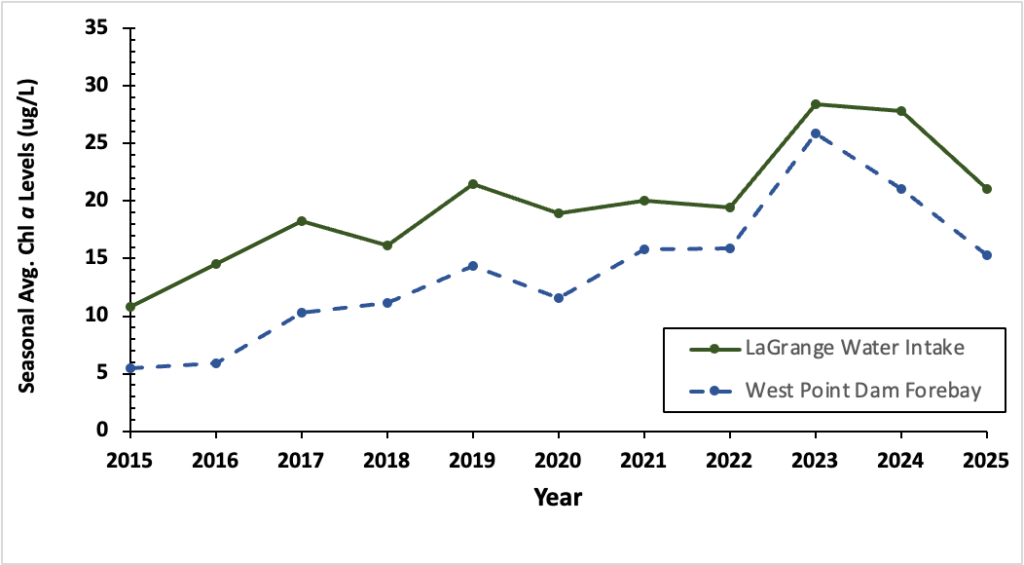
CRK and EPD seasonal chlorophyll-a data averaged together.
Because of its location on the Chattahoochee River downstream of Metro Atlanta, West Point Lake is vulnerable to pollutants from many sources, including muddy sediment from development, fertilizers from lawns, leaking sewer pipes, and septic systems in disrepair.
CRK worked throughout the late 1990s and early 2000s to make the City of Atlanta overhaul its failing sewer system. After Atlanta made improvements to their sewer system, water quality downstream improved significantly. West Point Lake water quality data collected by EPD in 1986 had a seasonal chlorophyll-a average of 44 ug/L. When CRK started monitoring in 2014, the seasonal average was 12 ug/L.
Averages slowly increased each successive year, but algae levels made a significant jump in 2023 and 2024. For example, at the City of LaGrange water intake station on West Point Lake, chlorophyll-a levels increased from 19 ug/L in 2022 to almost 28 ug/L in 2023. The standard set by EPD for that station is 24 ug/L. In 2025, chlorophyll-a levels registered below the EPD standard at 20 ug/L.
CRK also monitors water quality in West Point Lake through our volunteer-based Neighborhood Water Watch program. Water samples are collected every week and promptly analyzed for turbidity, conductivity, and E. coli bacteria. During the summer recreation season, we publish a Swim Guide – a series of maps with red or green lights to help the public decide if it is safe for primary contact recreation at popular swimming spots on the Chattahoochee River. Sites on West Point Lake commonly receive a green light for swimming.
CRK is in communication with EPD as well as the U.S. Army Corps of Engineers West Point Project, Troup County, City of LaGrange, and others. We stand ready to work with our partners through a TMDL to ensure there is enough clean water in West Point Lake now and for future generations.
For more information, contact Henry Jacobs, CRK Deputy Director, at 404-352-9828 ext. 315 or hjacobs@chattahoochee.org.
Related Posts
New reports of musty drinking water in Lake Lanier, metro Atlanta communities
Do you live in Metro Atlanta or around Lake Lanier? Have you noticed that your tap water tastes musty or like dirt? Drinking water providers around north Georgia that draw…
Investigation of Atlanta fish kill continues
June 24, 2026 | Chattahoochee Riverkeeper (CRK) continues to investigate the unprecedented May 20-22, 2026 fish kill on the Chattahoochee River directly downstream of Peachtree Creek in Atlanta, Georgia. During a routine patrol of the…
What is a floating wetland trash trap?
In honor of Earth Day, Chattahoochee Riverkeeper partnered with the City of Chamblee and Cox Enterprises to install a “floating wetland trash trap” designed to capture litter, host native wetland…
 English
  Spanish